
Description
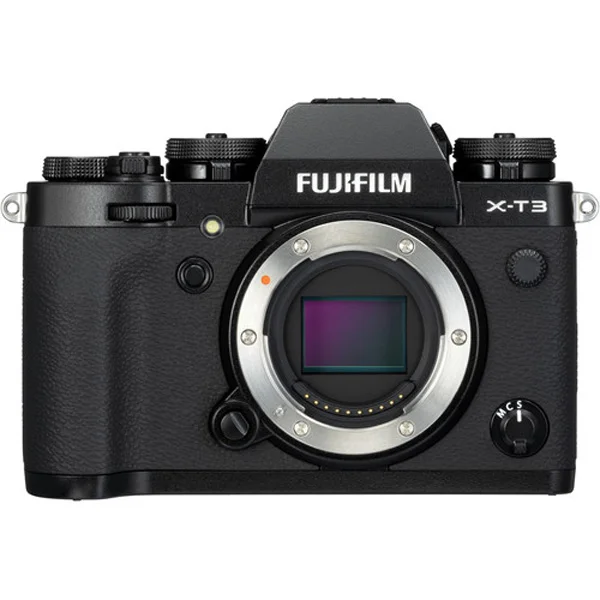
FUJIFILM X-T3 BLACK
Designed for videographers and action photographers, the black Fujifilm X-T3 is characterized by its high-speed performance, superior imaging capabilities, and multimedia flexibility. It combines a new 26MP APS-C X-Trans CMOS 4 sensor (10 times faster readout) with the X-Processor 4 image processor. This new sensor features a back-illuminated design (Fujifilm’s first) to improve image quality across the entire sensitivity range and to benefit from a 2.16MP phase-detection autofocus system (approximately 100% coverage). Its AF system is 1.5 times faster than its predecessor, the X-T2. The new processor now uses four cores for faster image processing, as well as continuous shooting at up to 11 fps (up to 20 fps in electronic shutter and up to 30 fps in sports mode with a 1.25x crop) and 4K video recording at up to 60 fps.
Design and ergonomics
Like previous XT cameras, the black Fujifilm X-T3 retains its classic look and predominantly touch controls. However, it adds a new OLED electronic viewfinder design with a 3.69 MP resolution and a strong 0.75x magnification. This viewfinder has a high refresh rate of 100 fps for smooth viewing and remains blackout-free when shooting at a maximum frame rate of 30 fps. You can also use Sports Finder mode, which highlights the 16.6 MP crop area to give you extra space outside the frame to identify moving subjects. A 3.2-inch, 1.04 MP rear LCD screen can also be used for live view shooting and image playback. The X-T3 also features Bluetooth technology for wireless sharing and remote control. Constructed from magnesium alloy, the black FUJIFILM X-T3 is fully weather-sealed, making it ideal for working in harsh weather conditions.
26.1 MP APS-C X-Trans BSI CMOS 4 sensor and X-Processor 4
The X-T3’s new sensor, the 26.1MP APS-C X-Trans BSI CMOS 4 sensor, features a back-illuminated design. This design delivers uniform tonal reproduction and improved low-light performance. As an X-Trans sensor, it utilizes a randomized pixel array, which provides a high degree of image quality and sharpness by omitting an optical low-pass filter. Compared to conventional pixel patterns, the X-Trans design more closely mimics the organic nature of film to produce nuanced colors and tonal transitions, while also reducing moiré and aliasing.
The sensor design also incorporates an expanded phase-detection autofocus system, now boasting 2,160,000 points that cover virtually the entire sensor area. This AF system delivers faster, more precise focusing performance, along with low-light sensitivity down to EV -3. Complementing the imaging and focusing capabilities is an updated X-Processor 4. This provides faster focus response when tracking a subject and also supports face and eye detection AF when working in AF-C mode and during video recording.
The X-Processor 4 incorporates four cores for faster image processing. It improves overall performance with ultra-fast autofocus speeds (0.06 sec.), 0.17 sec. intervals, a 0.045 sec. shutter lag, and a 0.3-second startup time. It is capable of shooting bursts of up to 11 fps with a mechanical shutter and up to 30 fps with an electronic shutter. It also supports internal UHD 4K60 video recording with 10-bit output.
UHD and DCI 4K video recording
More than just a still camera, the Fujifilm X-T3 offers an attractive array of video features, including internal 4:2:0 10-bit UHD 4K60p video recording to a memory card and 4:2:2 10-bit recording via HDMI. And the X-T3 isn’t limited to « classic » 4K UHD recording (3840 x 2160 pixels). It also records in 4K DCI Cinema, at 4096 x 2160 pixels. DCI 4K30 and Full HD 1080p120 recording are also possible, and video files can be saved using MPEG-4 AVC/H.264 or HEVC/H.265 compression and 4K resolution. The speed of the quad-core X-Processor 4 enables a fast 17ms readout when recording 4K60 video, which helps reduce shutter distortion when recording moving subjects.
In addition to supporting 10-bit color depth, the X-T3 also includes an F-Log gamma setting, which provides a flat image for use in color grading software. This maximizes the potential dynamic range in challenging scenes and also allows for image adjustments to enhance tones, shadows, colors, and sharpness.
In addition, the camera has a 3.5mm microphone jack and a 3.5mm headphone jack for more advanced audio solutions.


